Fundamental Factors and Oil Prices: Recent Experience and Lessons for the Coming Decade Jeddah Energy Meeting June 22, 2008
Oil market fundamentals are driving the 5-year run-up in prices. World oil markets have become increasingly tight since 2003. Global demand growth, fed by worldwide economic growth, has exceeded non-OPEC supply growth. OPEC and…
Oil prices have increase by almost 300% since January 2003. Prior to 2000, oil prices were relatively stable and well below 30 per barrel. Starting in 2003, oil prices began climbing due to inventory tightening, increasing world oil…
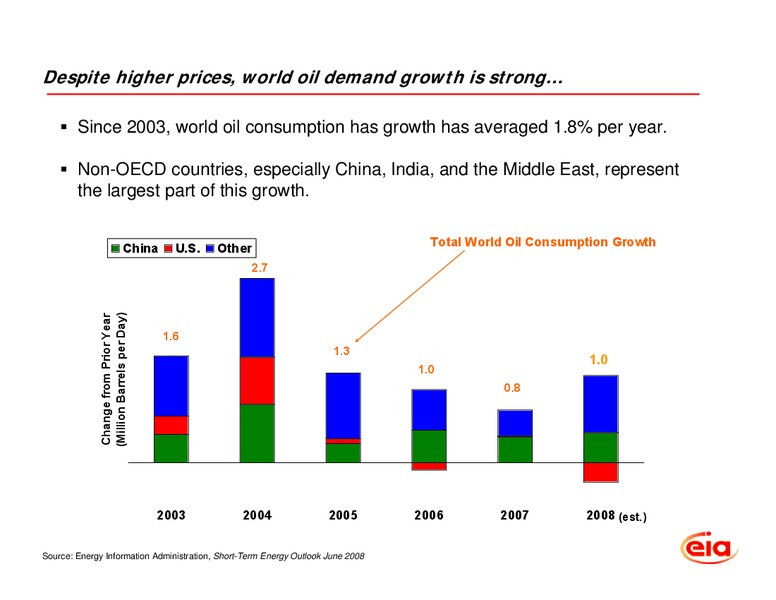
Despite higher prices, world oil demand growth is strong Since 2003, world oil consumption has growth has averaged 1.8% per year. Non-OECD countries, especially China, India, and the Middle East, represent the largest part of this…
while overall non-OPEC supply growth has slowed in recent years. In the past three years, non-OPEC supply growth has been well below levels seen just four years ago. Russia drove non-OPEC supply growth during the first part of the…
As a result, the world oil market balance has tightened significantly. World oil consumption growth has outpaced non-OPEC supply growth every year since 2003. This imbalance increases reliance upon OPEC production and/or inventories…
World surplus production capacity remains low, leaving world oil markets vulnerable to supply disruptions. Current world surplus production capacity is below historic levels. In addition, it is highly concentrated in a few countries,…
At low levels of spare capacity, oil prices tend to increase dramatically. Prices respond when surplus capacity is low, particularly when geopolitical turmoil or other events such as hurricanes threaten supply. Consider the…
OECD commercial stocks: from record highs to near-normal levels. OECD stocks were at record lows in 2003, following the strike in Venezuela. Preliminary OECD inventory data for the first part of 2008 shows that OECD stocks have again…
U.S. inventories for crude oil and key petroleum products are all relatively low. After remaining relatively high for much of 2006 and the first half of 2007, U.S. crude oil inventories have fallen towards the bottom end of the average…
The present situation differs dramatically from that in the 1970s, and requires a different strategy by major oil exporters. Between 1973 and 1985, OPEC production fell dramatically, squeezed by anemic demand growth and a strong supply…
 Loading...