

Quarterly / Earnings Reports | Second Quarter (2Q) Update | Oil Sands | Production Rates | Oil Sands Projects | Capital Markets | Capital Expenditure
Imperial Oil Maintains Tight Focus on Completing Upstream Projects
 Print
|
Print
|

Imperial Oil has announced second quarter 2015 results:
Second quarter highlights
- Production averaged 344,000 gross oil-equivalent barrels per day, up 20 percent versus 287,000 barrels in the second quarter of 2014 due to higher Kearl and Cold Lake volumes. Production was at its highest level since the third quarter of 2007.
- Refinery throughput averaged 373,000 barrels per day, compared to 418,000 barrels in the same period of 2014. The decrease was mainly associated with major planned maintenance turnaround activity at the Sarnia refinery. Excluding the impact of the planned turnaround, capacity utilization averaged 97 percent.
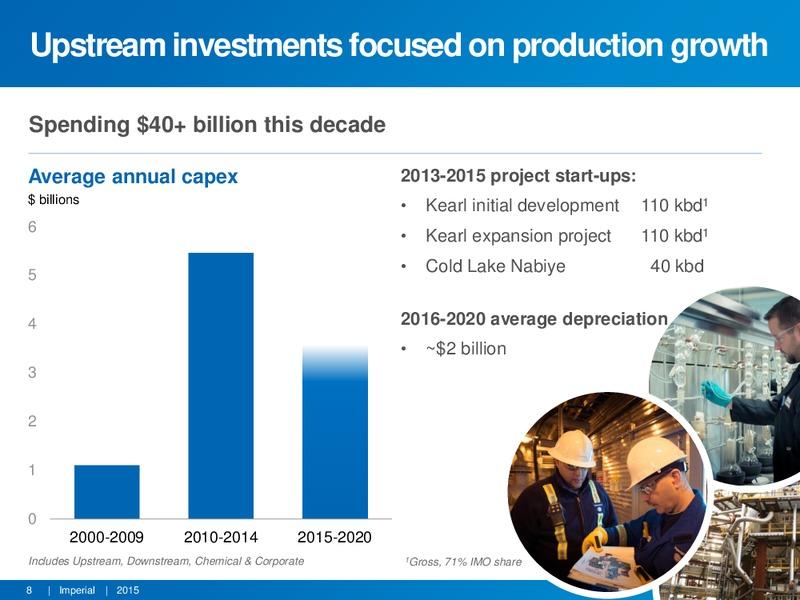
- Capital and exploration expenditures totalled $819 million, down $579 million versus 2014. Investments were primarily directed towards the completion of the major upstream growth projects.
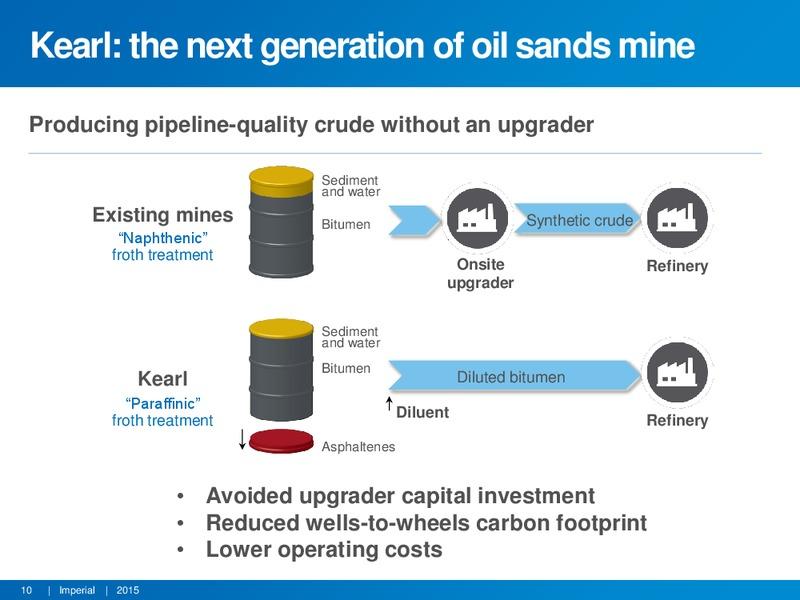
- Kearl bitumen production averaged 130,000 barrels per day in the quarter (92,000 barrels Imperial's share), up from 73,000 barrels per day (52,000 barrels Imperial's share) in the second quarter of 2014 and 95,000 barrels (67,000 barrels Imperial's share) in the first quarter of 2015. The increase was the result of the start-up of the expansion project and improved reliability of the initial development. Kearl expansion started up five months ahead of schedule and averaged more than 100,000 barrels per day (71,000 barrels Imperial's share) during its first full month of operations. This reflects the significant benefits of our "design one, build multiple" approach and the rigorous application of the lessons learned from the initial development.
- Cold Lake bitumen production averaged 161,000 barrels per day in the quarter, up from 138,000 barrels in the same quarter of 2014, with Nabiye production continuing to ramp-up following its first quarter 2015 start-up.
- Cold Lake Midzaghe project description was filed with the Alberta Energy Regulator. Midzaghe is a planned solvent-assisted, steam-assisted gravity drainage (SA-SAGD) project in the Cold Lake area to access more than 500 million barrels of recoverable reserves. The filing is the first step in the environmental assessment process and a precursor to public consultations with local stakeholders, including First Nations. Midzaghe is one of a suite of potential SA-SAGD projects in Imperial's portfolio. No final investment decision has been made at this time.
- The company's share of Syncrude production averaged 52,000 barrels per day in the second quarter. Subsequent to the safe completion of major planned maintenance activities, the plant resumed normal operations in June.
- Edmonton Rail Terminal project was successfully completed. The terminal is a joint venture operated by Kinder Morgan, and provides access for equity crude production to the highest-value markets. The facility is capable of loading unit trains, comprising 100 to 120 rail cars per train. The terminal has an initial capacity of 210,000 barrels per day with the potential to expand to 250,000 barrels.
- WCC LNG project proceeding through the B.C. environmental assessment process. After filing a project description in December 2014, the project is proceeding through the pre-application phase of the environmental assessment process, which includes public and Aboriginal engagement, Environmental Assessment Office working group participation and ongoing studies. A final investment decision, not anticipated in the near term, will ultimately be based on a number of factors, including satisfactory government and regulatory approvals, economic competitiveness, future market conditions and LNG sales agreements.
Second quarter 2015 vs. second quarter 2014
- Gross production of Cold Lake bitumen averaged 161,000 barrels per day in the second quarter, up from 138,000 barrels in the same period last year, primarily due to the continued ramp-up of Nabiye production. Nabiye production is expected to reach approximately 40,000 barrels per day, before royalties, by the end of 2015.
- Gross production of Kearl bitumen averaged 130,000 barrels per day in the second quarter (92,000 barrels Imperial's share) up from 73,000 barrels per day (52,000 barrels Imperial's share) during the second quarter of 2014, reflecting early start-up of the Kearl expansion project and continued improvement in reliability of the initial development.
- During the second quarter of 2015, the company's share of gross production from Syncrude averaged 52,000 barrels per day, up from 51,000 barrels in the second quarter of 2014.
- Gross production of conventional crude oil averaged 15,000 barrels per day in the second quarter, versus 18,000 barrels in the corresponding period in 2014. The lower production volume was primarily due to the impact of properties divested during the first half of 2014.
- Gross production of natural gas during the second quarter of 2015 was 134 million cubic feet per day, down from 158 million cubic feet in the same period last year, reflecting the impact of properties divested during the first half of 2014.
Six months highlights
- Gross oil-equivalent barrels of production averaged 339,000 barrels per day, up from 308,000 barrels from the same period in 2014.
- Refinery throughput averaged 383,000 barrels per day, compared to 398,000 barrels in the same period last year.
- Per-share dividends declared during the year totalled $0.26, unchanged from 2014.
Six months 2015 vs. six months 2014
- Gross production of Cold Lake bitumen averaged 156,000 barrels per day in the first six months, up from 142,000 barrels from the same period last year, primarily due to Nabiye production.
- Gross production of Kearl bitumen averaged 113,000 barrels per day in the first six months of 2015 (80,000 barrels Imperial's share) up from 72,000 barrels per day (51,000 barrels Imperial's share), reflecting early start-up of the Kearl expansion project and improved reliability of the initial development.
- During the first six months of 2015, the company's share of gross production from Syncrude averaged 63,000 barrels per day, up from 62,000 barrels from the same period of 2014.
- Gross production of conventional crude oil averaged 15,000 barrels per day in the first half of 2015, compared to 20,000 barrels during the same period of 2014.The lower production volume was primarily due to the impact of properties divested during the first half of 2014.
- Gross production of natural gas during the first six months of 2015 was 140 million cubic feet per day, down from 181 million cubic feet in the same period last year, reflecting the impact of properties divested during the first half of 2014.
Rich Kruger, Chairman, President and Chief Executive Officer, commented:
Imperial's second quarter results reflect continued strong operating performance across all business lines in a challenging business environment. Highlights for the quarter include the early start-up of the Kearl expansion project, continued ramp-up of Cold Lake Nabiye production, start-up of the Edmonton Rail Terminal, successful execution of major turnarounds at the Sarnia refinery and Syncrude, and best-ever quarterly earnings in the Chemical business.
Earnings in the second quarter were $120 million, or $0.14 per share, and reflected a net charge, largely non-cash, of $320 million ($0.38 per share) associated with the recently enacted Alberta corporate income tax rate increase. Earnings in the second quarter of 2014 included a gain of $478 million associated with the divestments of conventional upstream producing assets.
Gross production averaged 344,000 oil-equivalent barrels per day, up 57,000 barrels from 2014 due to increased Kearl and Cold Lake production. This result was the company's highest quarterly production level in nearly eight years. At Kearl, production averaged 130,000 barrels per day (92,000 barrels Imperial's share) in the quarter, driven by the expansion project start-up five months ahead of schedule and improved reliability in the initial development.
Refinery throughput averaged 373,000 barrels per day, compared to 418,000 barrels per day in the same period of 2014, reflecting planned turnaround activity at the Sarnia refinery. Capacity utilization excluding the turnaround continued to remain high at 97 percent.
Second quarter capital and exploration expenditures totalled $819 million, down $579 million versus 2014, as the Cold Lake Nabiye and Kearl expansion projects progressed toward completion.
Imperial continues to deliver results in the current business environment by focusing on what we can control. Specifically, we are relentlessly pursuing cost efficiencies, critically evaluating our investment decisions and increasing productivity in all areas of our business. This results-oriented approach is strengthening our resiliency, ensuring the company remains well-positioned throughout the commodity price cycle. Above all, our focus remains on delivering superior, long-term shareholder value in whatever business environment we operate in.
More Oil Sands Projects News

Cenovus Hits Production Milestone at Oil Sands Facilities; One Billion Barrels
Cenovus Energy Inc. has reached one billion barrels of cumulative production from its Foster Creek and Christina Lake oil sands facilities in northern Alberta. Cenovus is the first…

CNRL Hits One Billion Barrel Milestone at Athabasca Oil Sands Project
Canadian Natural Resources has achieved a mined production milestone of 1 billion barrels at its Athabasca Oil Sands project since operations began in 2003. Canadian Natural’s President Tim…

Husky Energy Upstream Production Down on Asset Sales
Increased production of 327,000 barrels of oil equivalent per day (boe/day) and steady refining throughputs contributed to funds from operations of $670 million and free cash flow of…

CNRL Horizon Project on Target for Phase 3 Expansion in Q4
Operations update for Horizon Oil Sands.

Asset Sales Bring Production Down for Husky Energy
About 27,000 boe/day sold in 2016 for gross proceeds of $1.3 billion.
Canada News

Western Canada Upstream M&A: Q1 2026 Transaction Report
Western Canadian M&A activity in Q1 2026 was characterized by a 87% decrease in total deal value compared to Q1 2025, totaling $0.8 billion C$. However, transaction volume…

Canadan E&P 2026 Program Calls for 448 Net Wells, Up 24% vs. 2025 Plan
Canadian Natural Resources outlined a 2026 operating capital budget of approximately $6.3 billion (total capital budget $6,425 million, including $125 million for carbon capture) targeting 1,590–1,650 MBOE/d of…

EIA’s “Glut” Calls: The 2025 Surplus Claim — and How 2021–2024 Forecasts Actually Held Up
The “~2.2 MMb/d glut in 2025” framing traces to the EIA’s Short-Term Energy Outlook (STEO), December 2025. EIA doesn’t usually write “glut” in the tables—what they publish is…

Whitecap Details 2026 Duvernay & Montney Program
Whitecap Resources reported strong third quarter 2025 operating and financial results, marking its first full quarter following the strategic combination with Veren that closed on May 12, 2025.…

ARC Resources: Lower 2026 Capex, Higher Volumes
ARC Resources used its third quarter update to reinforce a familiar message to Canadian E&P executives: disciplined capital, structurally better market access, and a growing shareholder return program…
North America News

Baytex 2026 Development Plans
Baytex’s 2026 development plan reflects a post–Eagle Ford sale capital program and a sharpened focus on its core Canadian assets. The Company approved 2026 exploration and development expenditures…

Tourmaline: 2026 Capital Program Locked In at $2.9B
Tourmaline’s 2026 exploration and production (EP) program is set at $2.9 billion and targets average production of 690,000–710,000 boepd, with the company maintaining the multi-year EP Plan released…

Cenovus Outlines 2026 Development Plan Following MEG Integration
Cenovus’ 2026 plan targets capital investment of $5.0 billion to $5.3 billion (including ~$350 million of capitalized turnaround costs) and upstream production of 945,000 BOE/d to 985,000 BOE/d,…

Gran Tierra Energy To Step Down Activity in 2026
Gran Tierra Energy’s 2026 development plan reflects a step-down in spending and activity as the company transitions from fulfilling Ecuador exploration commitments in 2025 toward a free-cash-flow-focused program.…

Advantage Plans $300–$330MM 2026 Capital Program
Advantage’s 2026 development plan centers on Glacier-focused drilling and key midstream work. The company plans total capital spending of $300 million to $330 million and expects production to…