

Drilling & Completions | Well Cost | Well Lateral Length | Quarterly / Earnings Reports | Third Quarter (3Q) Update | Drilling Activity
Laredo Touts Increased Efficiencies in Q3; Success with Higher Density Tests
 Print
|
Print
|
Laredo Petroleum reported its Q3 2018 results.
2018 Third-Quarter Highlights
- Produced a Company record 71,382 BOEPD in Q3 - up +19% YOY and up +6% from 2Q18
- In Q3, Laredo completed 16 gross (16 net) horizontal wells with an average completed lateral length of approximately 11,300 feet
Improves Drill Times 25% YOY
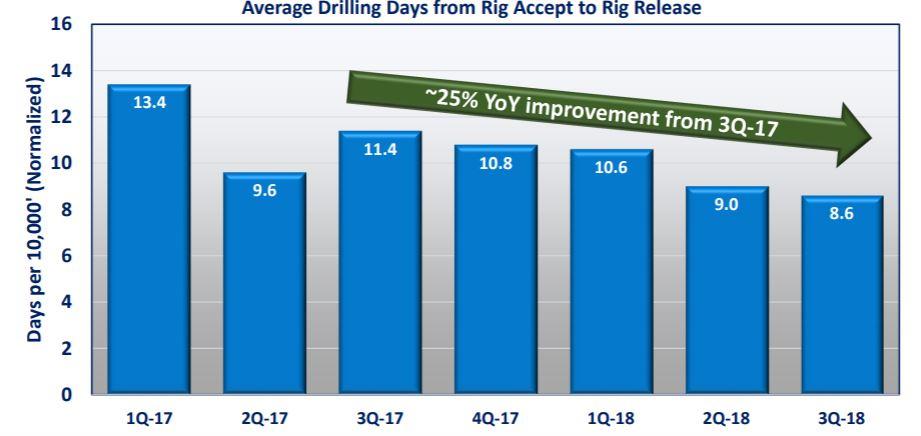
The company touted its operational efficiencies, including improved drill times and feet completed per rig.
Operational efficiencies continued to improve in the third quarter of 2018. Drilling operations set a Company record for average drilling days per 10,000-foot lateral of 8.6 days, a 25% improvement YOY.
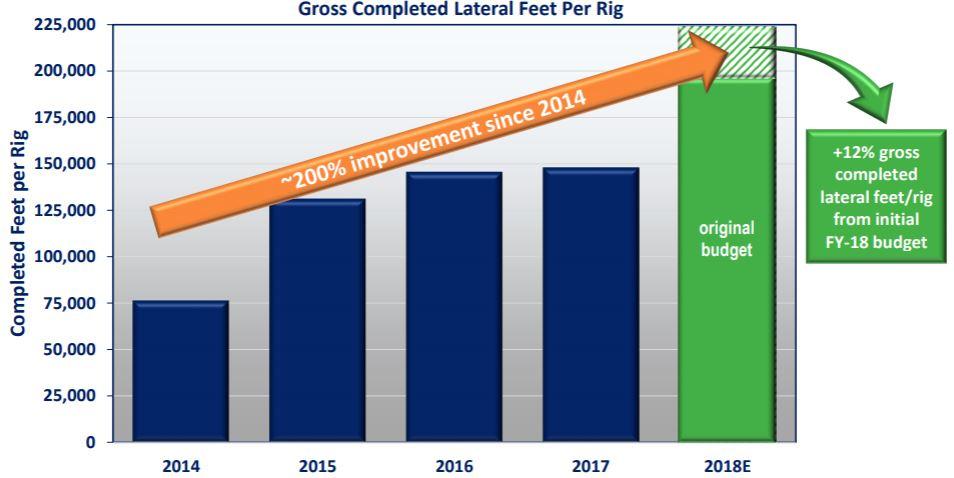
Combined with the 53% improvement in completions efficiencies compared to third-quarter 2017, Laredo expects gross completed lateral feet per rig to increase approximately 50% in 2018 versus 2017.
Working on Optimizing Density
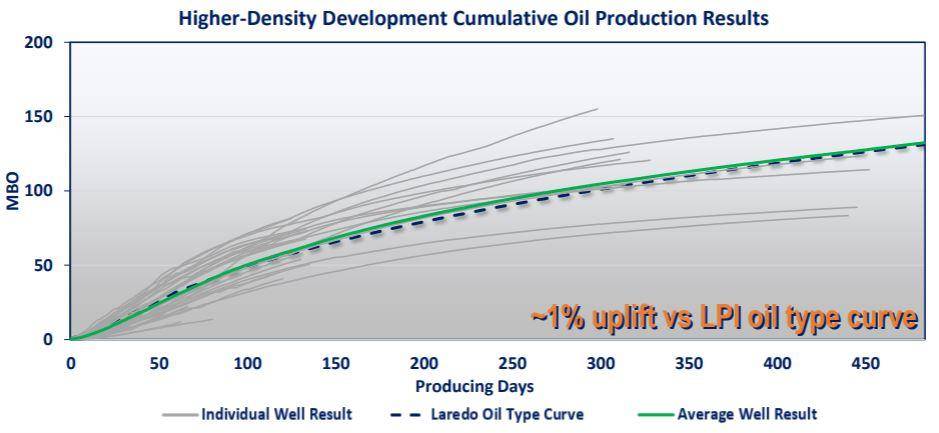
CEO Randy Foutch commented: "During the past 18 months, Laredo has worked to implement a development plan that maximizes the long-term value of our leasehold through high-density drilling. We have executed six packages of wells designed to co-develop multiple landing points in our Upper and Middle Wolfcamp formations at a density of 24 to 32 wells per drilling spacing unit and have another three high-density packages in process. The results of these high-density packages have successfully demonstrated that this development plan can increase the total value of our leasehold, albeit at lower per well value than lower-density development. As we seek to balance rate of return and capital efficiency with overall value, while minimizing our outspend, we are beginning to widen our well spacing and develop packages at a lower density."
Based on the productivity of high-density packages developed at 24 to 32 wells per DSU in the Upper/Middle Wolfcamp, Laredo has begun to plan lower-density development on packages to be drilled at the end of the fourth quarter of 2018 and is building the Company's 2019 budget to include lower-density development. The Company believes lower-density development of 8 to 16 wells per DSU in the Upper/Middle Wolfcamp will better balance higher- return drilling and capital efficiency with future value. The majority of completions in the first half of 2019 will consist of higher-density packages, with the transition to completions of lower-density packages expected to occur in the second half of 2019.
The 11-well Fuchs package, a high-density co-development package based on 32 wells per DSU and completed in the second quarter of 2018, is producing mixed results. Laredo is evaluating production data to better understand the individual productivity impact of landing point selection, lateral length and parent/child impact in relation to horizontal and vertical spacing in this package.
E&P Update
During third-quarter 2018, 14 of the 16 completed wells were in two larger, high-density packages. The six-well Sugg-D 104 package was a co-development package based on 24 wells per drilling spacing unit ("DSU") and an average lateral length of approximately 15,000 feet. Due in part to the longer clean-up times associated with 15,000-foot laterals, this package is currently underperforming the Company's lateral-length adjusted Upper/Middle Wolfcamp type curve. Although production has reached its peak, the Company expects the underperformance versus the type curve to improve as the package's decline rate is relatively shallow. The second package, the eight-well Barbee package based primarily on 32 wells per DSU, was completed at the end of the third quarter of 2018 and has not yet reached peak production.
The 11-well Fuchs package, a high-density co-development package based on 32 wells per DSU and completed in the second quarter of 2018, is producing mixed results. Laredo is evaluating production data to better understand the individual productivity impact of landing point selection, lateral length and parent/child impact in relation to horizontal and vertical spacing in this package.
During the third quarter of 2018, the Company began utilizing in-basin sand on all of its completions, resulting in the previously expected savings of approximately $400,000 per well. Laredo estimates its current well cost for a 10,000-foot Upper/Middle Wolfcamp well to be approximately $7.4 million.
More Third Quarter (3Q) Update News

Keystone Runs Steady as Blackrod Gas Link Nears Startup
Nov. 13, 2025 South Bow’s 3Q25 update was operationally focused: the Keystone Pipeline System maintained steady utilization while the company advanced integrity work tied to the MP-171 incident,…

Evolution Petroleum Corporation Fiscal Third Quarter 2023 Results
Evolution Petroleum Corporation announced fiscal third quarter 2023 results. Highlights Reported sequential growth in revenue of 9% to a record $36.9 million and in net income of 34%…

Civitas Resources Third Quarter 2022 Results
Civitas Resources, Inc. announced its third quarter 2022 financial and operating results. Third Quarter 2022 Highlights: Average daily sales volumes of 176.3 thousand barrels of oil equivalent per…

Murphy Oil Third Quarter 2022 Results
Murphy Oil Corp. announced its financial and operating results for the third quarter 2022. Murphy reported net income attributable to Murphy of $528 million, or $3.36 per diluted…

ConocoPhillips Third Quarter 2022 Results
ConocoPhillips reported its third quarter 2022 results. The company reported third-quarter 2022 earnings of $4.5 billion, or $3.55 per share, compared with third-quarter 2021 earnings of $2.4 billion,…
Permian News

Why $90 Oil Isn’t Bringing Back the Rigs
Higher oil prices are not translating cleanly into a drilling response across U.S. shale, and company disclosures are starting to show why. The issue is not simply capital…

These Three Companies Will Increase Drilling & Completion Over The Next 3 Year
In the span of fifteen months, three Japanese energy companies committed more than $10.3 billion to U.S. natural gas production assets — a buying spree that has transferred…

Q1 A&D Transactions Jump to $30B , While Deal Flow Was Down 40%
The first quarter of 2026 has officially defined the "Barbell Era" of American oil and gas. While the total number of deals plummeted by 46% YoY (dropping to…

Wright to U.S. Oil Industry: The Price Signal Is Telling You to Drill
Energy Secretary Chris Wright stood in front of the largest gathering of oil executives in the world this morning and delivered a message that was equal parts market…

Apa Corp : Doing More With Less
APA's 2025 narrative was one of operational surprise. The company came in beating production guidance every single quarter while spending below plan, capturing over $300MM in cost savings…
Permian - Midland Basin News

Permian Resources to Grow Production 6% in 2026
Permian Resources exited 2025 as the largest pure-play Delaware Basin operator with ~480,000 net acres and >105,000 net royalty acres. The company averaged 392.6 MBoe/d in 2025, including…

Battalion Oil Closes ~$60M West Quito Draw Asset Sale
Battalion Oil Corporation has closed the sale of its West Quito Draw assets in the Southern Delaware Basin to MCM Delaware Resources LLC, a subsidiary of MCM Energy…

Deal Rumor: ConocoPhillips Exploring $2B Permian Asset Sale
ConocoPhillips is reportedly exploring the potential sale of certain Permian Basin assets in a transaction valued at approximately $2 billion, according to Reuters, citing sources familiar with the…
This Operator Will Chop it's 2026 Rig Count From 34 to 24
ConocoPhillips is setting up 2026 as a lower-intensity, more efficient operating year — with the clearest proof coming from the Lower 48 activity reset following the Marathon integration.…

A Quiet Capital Pattern Is Forming in North American Upstream — and Almost No One Is Talking About It
A handful of recent transactions and capital raises point to a subtle pattern in North American upstream—one that is easy to miss because each event, on its own,…