

Quarterly / Earnings Reports | First Quarter (1Q) Update | IP Rates-24 Hour | Initial Production Rates | Capital Markets | Capital Expenditure | Drilling Activity
Matador Reports Only Three Completions in 1Q; Reaffirms 3-Rig Plan
 Print
|
Print
|

Matador Resources Company reported financial and operating results for the three months ended March 31, 2016.
Key Points:
- During the first quarter of 2016, Matador operated three drilling rigs in the Delaware Basin.
- Future Rig Plans: Matador expects to operate two rigs at Rustler Breaks until the end of the second quarter, at which time it will move one of these rigs to its Ranger and Arrowhead prospect areas in Lea and Eddy Counties, New Mexico for the remainder of 2016.
- Due to focusing on several multi-well pads at Wolf and Rustler Breaks, the Company placed only three operated wells on production in the Delaware Basin during the first quarter of 2016
Joseph Wm. Foran, Matador’s Chairman and CEO, commented, “The first quarter of 2016 progressed consistent with the guidance and projections provided at our Analyst Day presentation on February 3 in Dallas. Our production was in line with our original forecasts for the quarter, despite the negative impacts of winter weather shut-ins in the Delaware Basin in early January and of flooding rains in Northwest Louisiana in early March, which kept portions of our Haynesville and Cotton Valley natural gas production in the Elm Grove area shut in for two to three weeks.
“The highlight of the quarter operationally was the increase in our proved oil and natural gas reserves, which increased to 90.2 million BOE at March 31, 2016, an all-time high for Matador, and a year-over-year increase of 14% from 79.3 million BOE at March 31, 2015, despite the continued decline in commodity prices over a period of almost two years. Our proved oil reserves increased to 50.7 million barrels at March 31, 2016, also an all-time high, and a year-over-year increase of 56% from 32.5 million barrels at March 31, 2015. These increases in total proved reserves—and especially in our proved oil reserves—are primarily attributable to our ongoing delineation and development drilling and completion operations in the Delaware Basin.
“We continued to make steady improvements in our drilling and completion efficiencies and well costs in the Delaware Basin in the first quarter of 2016, and the Operations Update included with this earnings release highlights a number of these recent achievements. Our oil production in the second quarter is expected to increase approximately 10 to 12% as we bring new production online from several multi-well pads drilled in our Wolf and Rustler Breaks prospect areas where we completed a number of wells in late March and into the first part of the second quarter. Matador’s drilling and completion engineers continue to innovate and use the latest available technologies to reduce our drilling times and costs and to achieve better well results from our completion operations. With the recent completion of several new wells on the Dick Jay and Dorothy White multi-well pads in our Wolf prospect area, the second quarter is off to a strong start. At the start of May, our production had increased from average first quarter production of approximately 23,800 BOE per day, consisting of 11,500 barrels of oil per day and 74.2 million cubic feet of natural gas per day, to approximately 27,300 BOE per day, consisting of about 13,700 barrels of oil per day and 81.7 million cubic feet of natural gas per day. Matador expects to complete and place on production 16 new operated wells in our Wolf and Rustler Breaks prospect areas during the second quarter.
“Financially, our results reflect the low commodity prices experienced during the first quarter of 2016, which were the lowest in many years and certainly the lowest in any period since Matador became a public company. Despite the tough commodity price environment, however, we continued to keep our balance sheet strong, raising approximately $142 million through the sale of equity during the first quarter, providing us with ample liquidity to continue our three-rig drilling program and associated midstream activities in the Delaware Basin. The recent rally in commodity prices, and particularly in oil prices, has been encouraging, and both the increase in our production and the rise in commodity prices should result in a much stronger second quarter. We anticipate continued production growth and improvement in our operating results throughout the remainder of 2016.”
Operations Update
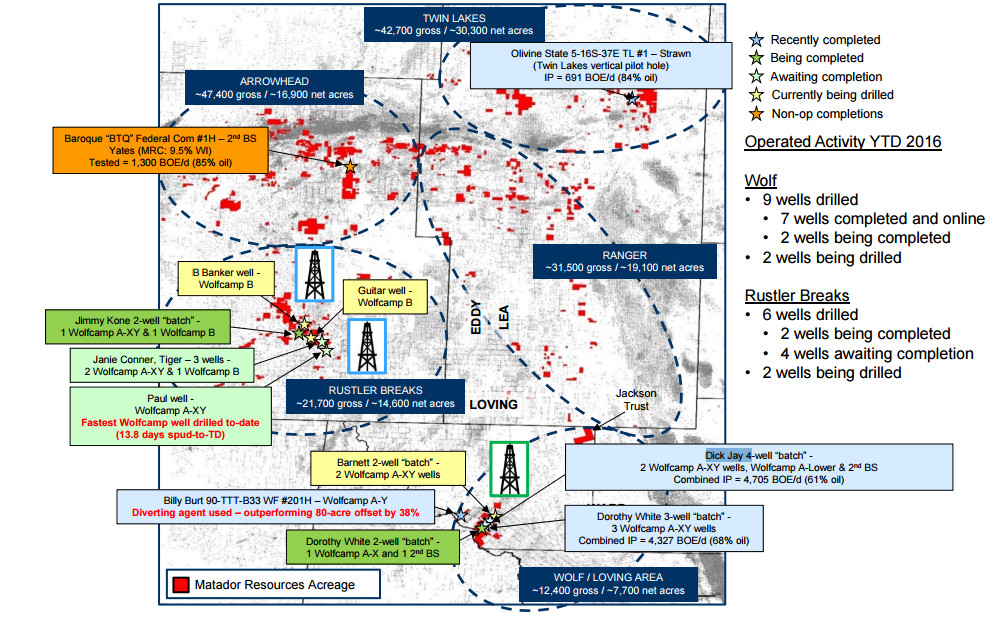
Delaware Basin - Southeast New Mexico and West Texas
During the first quarter of 2016, Matador operated three drilling rigs in the Delaware Basin. Early in the first quarter, two of these rigs were operating in the Wolf prospect area in Loving County, Texas and one was operating in the Rustler Breaks prospect area in Eddy County, New Mexico. In late February, one of these rigs was moved to Rustler Breaks, and since that time and at May 3, 2016, two rigs were operating at Rustler Breaks and one rig was operating at Wolf. Matador expects to operate two rigs at Rustler Breaks until the end of the second quarter, at which time it will move one of these rigs to its Ranger and Arrowhead prospect areas in Lea and Eddy Counties, New Mexico for the remainder of 2016. These plans are consistent with the 3-rig drilling program outlined by Matador at its Analyst Day on February 3, 2016 and affirmed in its February 24, 2016 earnings release and subsequent investor presentations.
Matador’s first quarter was primarily focused on drilling activities, particularly with the drilling of several multi-well pads at Wolf and Rustler Breaks. As a result, the Company placed only three operated wells on production in the Delaware Basin during the first quarter of 2016, one of which, the Dick Jay 92-TTT-B01 WF #124H (Dick Jay #124H), a Second Bone Spring completion in the Wolf prospect area, was placed on production in mid-March and thus did not contribute fully to first quarter production volumes. As a result, the Company’s oil production declined 2%, while total oil equivalent production remained flat in the first quarter of 2016, as compared to the fourth quarter of 2015. Matador expects a significant increase in its oil, natural gas and total oil equivalent production in the second quarter of 2016 as more of the wells drilled in the first quarter, and wells currently being drilled, are completed and placed on production.
At May 3, 2016, Matador has drilled nine wells in its Wolf prospect area year-to-date, with seven of those wells now completed and on production and two more just beginning to flow back and clean up following stimulation operations. The Company is currently drilling a two-well pad (both Wolfcamp A-XY wells) on its Barnett lease in the Wolf prospect area. Matador has drilled six wells in its Rustler Breaks prospect area year-to-date, with two of those wells having just been completed and four more awaiting completion. The Company is running two rigs at Rustler Breaks, both drilling Wolfcamp B wells on the B. Banker and Guitar leases, respectively. Matador did not complete as many wells in the first quarter of 2016 as originally planned, while it finalized negotiations on a new fracturing services pricing agreement for 2016. As a result, the Company is currently using two fracturing crews in order to complete its back-log of recently drilled wells and to place these wells on production as soon as possible. Matador estimates that it will complete and place on production 16 gross (13.7 net) wells throughout the second quarter of 2016.
Matador’s Delaware Basin assets continue to be an increasingly important component of the Company’s portfolio. During the first quarter of 2016, Matador’s Delaware Basin production averaged approximately 10,000 BOE per day (consisting of 7,172 Bbl of oil per day and 16.7 million cubic feet of natural gas per day). Matador’s Delaware Basin production grew 2.8-fold from an average total production of approximately 3,500 BOE per day in the first quarter of 2015 (consisting of 2,467 Bbl of oil and 6.5 million cubic feet of natural gas per day) and increased 14% from an average total production of about 8,700 BOE per day in the fourth quarter of 2015 (consisting of 6,117 Bbl of oil per day and 15.6 million cubic feet of natural gas per day).
Matador’s midstream operations continue to proceed as planned. As previously reported, Matador is currently building a cryogenic natural gas processing plant and the associated natural gas gathering system in the Rustler Breaks prospect area to support its future development efforts there. The Rustler Breaks natural gas processing plant is expected to have an inlet capacity of approximately 60 million cubic feet of natural gas per day. At May 3, 2016, the construction of the Rustler Breaks plant is proceeding on time and on budget, and Matador expects the plant to become operational during the third quarter of 2016.
Wolf/Loving Prospect Area - Loving County, Texas
At May 3, 2016, Matador is operating one drilling rig in its Wolf prospect area and expects to run at least one rig in this area throughout 2016. From January 1 through late February 2016, Matador operated two drilling rigs in the Wolf prospect area. One of these rigs drilled a four-well pad in “batch” mode (the Dick Jay pad), testing the Wolfcamp A-XY (two horizontals, one in the A-X and one in the A-Y), the Wolfcamp A-Lower and the Second Bone Spring. As noted above, the Dick Jay #124H well, the Second Bone Spring test, was completed and placed on production during March 2016. The remaining three wells, the Dick Jay 92-TTT-B01 WF #203H (Dick Jay #203H), the Wolfcamp A-Y test, the Dick Jay 92-TTT-B01 WF #204H (Dick Jay #204H), the Wolfcamp A-X test, and the Dick Jay 92-TTT-B01 WF #212H (Dick Jay #212H), the Wolfcamp A-Lower test, were completed and placed on production during April 2016. The second rig drilled a three-well pad in “batch” mode (the Dorothy White pad), with each well testing the Wolfcamp A-XY (three horizontals). The Dorothy White 82-TTT-B33 WF #202H and #204H wells (Dorothy White #202H and #204H) were Wolfcamp A-X tests and the Dorothy White 82-TTT-B33 WF #208H (Dorothy White #208H) was a Wolfcamp A-Y test. Each of these three wells was completed and placed on production in mid-to-late April. At May 3, 2016, Matador has drilled, completed and just initiated flowback after stimulation from two additional Dorothy White wells in the Wolf prospect, one Wolfcamp A-X and one Second Bone Spring test, and is currently batch drilling two new wells on its Barnett lease.
Matador continues to make progress in reducing drilling times and well costs for both Wolfcamp and Bone Spring horizontal wells in the Wolf prospect area. In the Wolfcamp, the Company’s most recently drilled well, the Dorothy White 82-TTT-B33 WF #203H, was drilled from spud to total depth of 15,550 feet in 17.3 days, as compared to average drilling times of 43 days in 2014 for similar depths. In the Second Bone Spring, the Dick Jay #124H was Matador’s fastest Second Bone Spring well drilled to date in this area at approximately 12.6 days from spud to total depth of 14,883 feet. In addition, the Company’s drilling engineers were able to eliminate a second intermediate casing string typically used when drilling the Second Bone Spring in this area. Not only did eliminating this casing string save approximately $650,000 in well costs, but it also provides for larger casing to be set through the lateral, thereby reducing hydraulic horsepower costs during fracturing operations and enhancing the number of artificial lift options available to the Company in the future. Furthermore, by drilling multiple wells in “batch” mode, Matador is able to reduce well costs even further. As an example, the Company estimates that it saved up to $400,000 in drilling costs per well, or a total of approximately $1.6 million, by drilling the four Dick Jay wells in “batch” mode on a single pad. Completion costs have also continued to improve significantly as a result of the Company’s efficiencies, technology and reduced service costs.
Matador has been very pleased by the initial performance from all four wells drilled and completed on the Dick Jay pad, which had an aggregate 24-hour initial potential of approximately 4,700 BOE per day, including 2,855 Bbl of oil per day and 11.1 million cubic feet of natural gas per day. Matador has a working interest of approximately 79% in each of these wells. The 24-hour initial potential test results from each well are summarized in the table below.
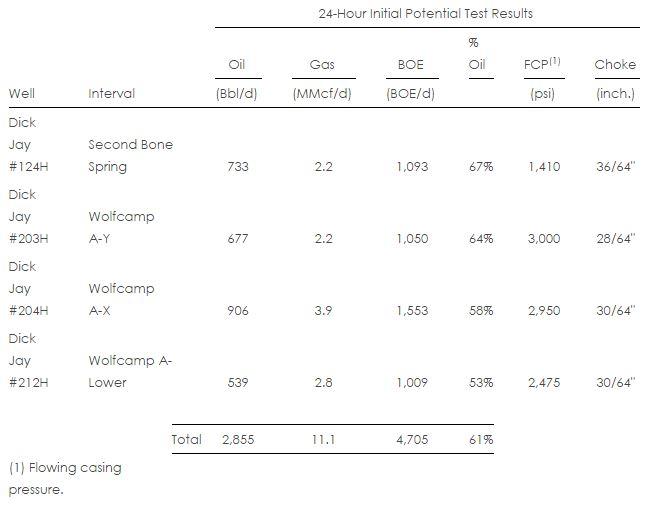
The Dick Jay #124H, the Second Bone Spring test, flowed approximately 1,100 BOE per day (67% oil), which exceeded the Company’s expectations and is a significant improvement over Matador’s first Second Bone Spring test in this area. Matador pumped a larger fracture treatment on the Dick Jay #124H well, using 40 barrels per foot of fracturing fluid and 2,000 pounds of 20/40 sand per foot of lateral compared to its previous Second Bone Spring completion in the Wolf prospect area, which used only 20 barrels per foot of fracturing fluid and about 1,300 pounds of 30/50 sand per foot of lateral. Matador also ran flow-through plugs with dissolvable balls for the first time on this well; these dissolvable balls performed very well, eliminating the need for the plugs to be drilled out following completion, thus saving another $40,000 in well costs. Total costs for this well were approximately $4.4 million, some of which was attributable to extended flowback equipment used to test the Second Bone Spring completion while the deeper Wolfcamp laterals were being completed. In the near future, Matador estimates that it should be able drill, complete and equip Second Bone Spring wells in this area for under $4 million. Given the success of the Dick Jay #124H well, Matador is considering scheduling changes to allow for additional Second Bone Spring tests on its Wolf acreage during 2016.
The Dick Jay #203H (Wolfcamp A-Y) and the Dick Jay #204H (Wolfcamp A-X) wells are also excellent wells, with the Dick Jay #204H well having the second highest 24-hour initial potential flow rate recorded to date for any well drilled on Matador’s Wolf prospect. Both wells were completed using 40 barrels of fracturing fluid and just over 2,000 pounds of 30/50 sand per foot of lateral. In each of these wells, Matador revised the fracturing fluid chemistry by testing a new surfactant on the Dick Jay #203H and increasing surfactant concentration on the Dick Jay #204H. This revised fluid design assisted in clean up of the fracturing fluid, but it is still too early in the life of these wells to draw any conclusions as to the effectiveness of the surfactants on longer-term well performance.
The Dick Jay #212H marked Matador’s second test of the lower Wolfcamp A (Wolfcamp A-Lower), the more organically rich interval of the Wolfcamp, about 350 feet below the X and Y targets in the upper Wolfcamp. The initial performance of this well is also an improvement over the initial Wolfcamp A-Lower test, with higher total production, including higher oil and significantly better natural gas flow rates, and higher flowing pressures. Matador experimented with a hybrid slickwater/linear gel design on this well in an attempt to reduce fracture height growth and to focus more of the fracture treatment within the target formation. This well was stimulated with almost 50 barrels of fracturing fluid and about 2,200 pounds of 40/70 sand per foot of lateral. Early results suggest an improvement in overall well productivity in the Wolfcamp A-Lower as a result. In fact, the Dick Jay #212H well has continued to clean up and improve since its earlier 24-hour initial potential test as shown above, and at May 2, 2016, the well was producing 1,326 BOE per day (54% oil), consisting of 713 barrels of oil per day and 3.7 million cubic feet of natural gas per day.
Matador has also observed very strong initial performance from the three-well pad recently drilled and completed on the Dorothy White lease. These wells had an aggregate 24-hour initial potential of 4,327 BOE per day, including 2,940 Bbl of oil per day and 8.3 million cubic feet of natural gas per day. Matador has an average working interest of approximately 85% in these wells. The 24-hour initial potential test of the Dorothy White #204H well of 1,671 BOE per day is the highest initial potential flow rate recorded to date for any well drilled in the Wolf prospect area. The 24-hour initial potential test results from each well are summarized in the table below.
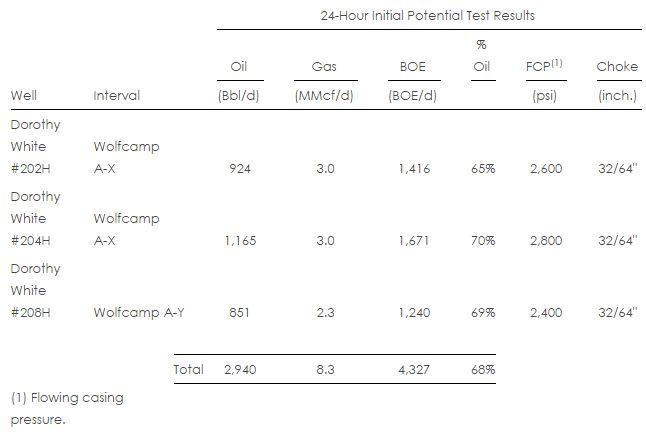
Each of the three wells on the Dorothy White pad was stimulated with 40 barrels of fracturing fluid and 2,000 to 3,000 pounds of 30/50 sand per foot of lateral. A diverting agent was pumped during each stage of the fracture treatment on each well, and as a result, more perforation clusters were used in each stage, resulting in longer stages. This, in turn, resulted in fewer fracture stages being pumped on each well; these wells were completed with 12 to 15 fracture stages, as opposed to 19 stages on each of the Wolfcamp A-XY wells completed on the Dick Jay pad. Matador also continues to be pleased with the early performance of the Billy Burt 90-TTT-B33 WF #201H well (Billy Burt #201H) where it used a diverting agent as part of the fracture stimulation treatment for the first time in late October 2015. After approximately six months of production, the Billy Burt #201H well had produced about 157,000 BOE, or about 38% more oil and natural gas than the immediate 80-acre offsetting well having a similar lateral length, but where no diverting agent was used.
Matador continues to test a variety of treatment modifications and treatment additives and new technologies in an effort to improve and optimize well performance from its Delaware Basin wells. In addition, Matador also continues to use recycled produced water in the stimulation of its newly drilled wells in the Wolf prospect area. Recycled produced water made up between 70% and 100% of the total water volumes used in the recent fracture treatments conducted on each of the nine wells drilled and completed on the recent Dick Jay and Dorothy White pads. Using recycled water saves the Company on costs to source fresh water, as well as the disposal costs associated with produced water, in addition to conserving fresh water for other uses in the Wolf area.
Rustler Breaks Prospect Area - Eddy County, New Mexico
At May 3, 2016, Matador is operating two drilling rigs in its Rustler Breaks prospect area in Eddy County, New Mexico and expects to run at least one rig in this area throughout 2016. The Company began its 2016 drilling campaign at Rustler Breaks in mid-February and has drilled six gross (5.3 net) wells in this area so far this year. None of these wells were completed and placed on production during the first quarter of 2016. The first two of these wells, a two-well batch on the Jimmy Kone pad testing the Wolfcamp A-XY and Wolfcamp B intervals, have now been completed and are just starting to flow back following stimulation. Four wells are waiting on completion, including three Wolfcamp A-XY tests and one Wolfcamp B test, all located in the southeast portion of the Rustler Breaks prospect area. These wells should be completed and placed on production during May. One of these wells, the Paul 25-24S-28E #221H, is now Matador’s fastest-drilled Wolfcamp well, being drilled in just 13.8 days from spud to total depth of 14,468 feet. Matador is currently drilling a Wolfcamp B test on its B. Banker lease south of the Dr. K 24-23S-27E RB #203H well (Dr. K # 203H) and a Wolfcamp B test on its Guitar lease, offsetting its Guitar 10-24S-28E RB #202H well (Guitar #202H) that was drilled and placed on production just over one year ago. Matador expects to continue to operate two rigs at Rustler Breaks throughout the second quarter. At the end of the second quarter, one of these rigs is expected to move to the Ranger and Arrowhead prospect areas for the balance of 2016.
Matador continues to be very pleased with the results of recent wells drilled in the Rustler Breaks prospect area. During the first quarter of 2016, the Janie Conner 13-24S-28E RB #224H well (Janie Conner #224H), a Wolfcamp B completion during the fourth quarter of 2015, continued to outpace the early performance of the Tiger 14-24S-28E RB #224H well (Tiger #224H), which was also drilled and completed in the Wolfcamp B formation in April 2015. As of late April 2016, the Janie Conner #224H well had produced approximately 157,000 BOE (56% oil) in almost 5.5 months of production. The Tiger #224H well had produced approximately 278,000 BOE (42% oil) in just over 13 months of production. Both wells continue to track above Matador’s one million BOE type curve for the Rustler Breaks area.
The Dr. K #203H well, a Wolfcamp A-XY completion late in the fourth quarter of 2015, also continued to perform well in early 2016. As of late April 2016, this well had produced approximately 86,000 BOE (71% oil) in about four months of production. The Dr. K #203H has exhibited comparable early performance with Matador’s initial Wolfcamp A-XY completion at Rustler Breaks, the Guitar #202H. The Guitar #202H well was placed on production in mid-March 2015 and has produced approximately 201,000 BOE (76% oil) in just over 13 months of production. Both are excellent wells and continue to track at or above Matador’s 800,000 BOE Wolfcamp A-XY type curve for the Rustler Breaks area. Matador’s best Wolfcamp A-XY completion at Rustler Breaks, however, the Tiger 14-24S-28E #204H well (Tiger #204H), continues to outperform both of these wells. As of late April 2016, the Tiger #204H well had produced approximately 214,000 BOE (78% oil) in its first 10 months of production and is tracking well above Matador’s 800,000 BOE Wolfcamp A-XY type curve for this area.
Ranger Prospect Area - Lea County, New Mexico and Arrowhead Prospect Area - Eddy County, New Mexico
Matador is not currently drilling in either its Ranger or Arrowhead prospect areas, but expects to return to drilling in these areas during the second half of 2016. The Company anticipates completing and placing on production five gross (3.9 net) wells in this area in the latter half of 2016, including two Second Bone Spring and three Third Bone Spring wells. The Third Bone Spring wells are scheduled to be drilled beginning in July 2016 and will be approximately 7,500-foot laterals.
Matador participated in one new, non-operated well on its Arrowhead acreage during the first quarter of 2016. This well, the Yates Petroleum Corporation Baroque “BTQ” Federal Com #1H well, tested at rates averaging approximately 1,300 BOE per day (including approximately 1,100 barrels of oil per day and 1.2 million cubic feet of natural gas per day) beginning in late March 2016. This well is located in the eastern portion of Matador’s Arrowhead prospect area in Eddy County, New Mexico. Matador owns a 9.5% working interest in this well, which provides yet another indication of the prospectivity of Matador’s northern Delaware Basin acreage.
Twin Lakes Prospect Area - Lea County, New Mexico
As discussed in its Analyst Day presentation on February 3, 2016, Matador drilled an initial data collection well, the Olivine State 5-16S-37E TL #1 (Olivine State #1), in its Twin Lakes prospect area during the fourth quarter of 2015. This was a vertical pilot hole drilled for the purpose of collecting whole core and a detailed suite of geophysical logs to assist Matador in determining the landing target for its initial horizontal test of the Wolfcamp D interval at Twin Lakes. The Company collected about 400 feet of whole core throughout much of the Wolfcamp D interval, and the core data and well logs are undergoing detailed description and analysis by both Matador’s geoscience staff and third-party vendors. Matador currently plans to drill its Wolfcamp D horizontal test in the fourth quarter of 2016.
The Olivine State #1 vertical pilot hole was drilled through the Wolfcamp D and into and through the Strawn formation below. The Strawn interval at about 11,500 feet is a complex carbonate formation that has previously produced significant quantities of oil and natural gas in the Twin Lakes area. Upon drilling through the Strawn interval, Matador’s geoscience staff analyzed the well logs taken across the interval and determined that there was the potential for a Strawn test in the Olivine State #1. As a result, the Olivine State #1 was perforated and completed in the Strawn interval with a small acid treatment during the first quarter of 2016.
Matador is pleased to announce that this vertical Strawn completion in the Olivine State #1 well referenced above flowed 691 BOE per day (84% oil) during a 24-hour initial potential test, consisting of 579 barrels of oil per day and 0.7 million cubic feet of natural gas per day, at a flowing surface pressure of 350 psi on a 32/64 inch choke. Given the positive results from this Strawn test, Matador now plans to produce the Olivine State #1 vertical well, rather than plug back, kick off and drill a horizontal Wolfcamp D test from this vertical wellbore as originally anticipated. Matador expects to drill a new horizontal well on the same pad to test the Wolfcamp D interval later this year. The Company also notes that there appear to be additional bypassed Strawn locations on its acreage in this area that may be targets for future Strawn vertical or horizontal tests.
Delaware Basin Acreage Update
At December 31, 2015, Matador held 157,100 gross (88,800 net) acres in the Permian Basin, primarily in Lea and Eddy Counties, New Mexico and Loving County, Texas. Between January 1 and May 3, 2016, the Company added approximately 2,500 gross (2,100 net) acres in Southeast New Mexico and West Texas, bringing Matador’s total Permian Basin acreage position to 158,000 gross (90,200 net) acres, almost all of which is located in the Delaware Basin. At May 3, 2016, these acreage totals included approximately 31,500 gross (19,100 net) acres in Matador’s Ranger prospect area in Lea County, 47,400 gross (16,900 net) acres in its Arrowhead prospect area in Eddy County, 21,700 gross (14,600 net) acres in its Rustler Breaks prospect area in Eddy County, 12,400 gross (7,700 net) acres in its Wolf and Jackson Trust prospect areas in Loving County and 42,700 gross (30,300 net) acres in its Twin Lakes prospect area in Lea County. Matador plans to continue its leasing and acquisition efforts in the Delaware Basin during 2016, and may also consider acquiring additional acreage in the Eagle Ford shale and Haynesville shale as strategic opportunities are identified.
First Quarter 2016 Operating and Financial Results
Production and Revenues
Three months ended March 31, 2016 as compared to three months ended March 31, 2015
Average daily oil equivalent production was up 1% from 23,513 BOE per day (48% oil by volume) in the first quarter of 2015 to 23,846 BOE per day (48% oil by volume) during the first quarter of 2016. Total oil production increased 3% from 1.01 million barrels of oil, or 11,206 barrels of oil per day, during the first quarter of 2015 to 1.04 million barrels of oil, or 11,473 barrels of oil per day, during the first quarter of 2016. This increase in oil production was primarily a result of Matador’s ongoing delineation and development drilling in the Delaware Basin, which offset declining oil production in the Eagle Ford shale where the Company has not drilled and completed any new operated wells since very early in the second quarter of 2015. Matador’s Delaware Basin oil production almost tripled year-over-year from approximately 222,000 barrels, or 2,467 barrels of oil per day, in the first quarter of 2015 to approximately 653,000 barrels, or about 7,172 barrels of oil per day, in the first quarter of 2016.
Total natural gas production was up 2% from 6.6 billion cubic feet of natural gas, or 73.8 million cubic feet of natural gas per day, during the first quarter of 2015 to 6.8 billion cubic feet of natural gas, or 74.2 million cubic feet of natural gas per day, during the first quarter of 2016. This increase in natural gas production was primarily attributable to increased natural gas production from Matador’s ongoing delineation and development drilling in the Delaware Basin. Matador’s Delaware Basin natural gas production increased 2.6-fold from 0.6 billion cubic feet of natural gas, or about 6.5 million cubic feet of natural gas per day, in the first quarter of 2015 to 1.5 billion cubic feet of natural gas, or approximately 16.7 million cubic feet of natural gas per day, in the first quarter of 2016. The Company achieved this increase despite its natural gas production being impacted negatively by severe flooding in Northwest Louisiana during the first quarter of 2016, which resulted in a portion of its Haynesville and Cotton Valley natural gas production, including both operated and non-operated properties in the Elm Grove area, being shut-in for two to three weeks. All of this natural gas production is now back online.
Oil and natural gas revenues decreased 30% from $62.5 million in the first quarter of 2015 to $43.9 million in the first quarter of 2016. Oil revenues decreased 31% from $43.7 million in the first quarter of 2015 to $30.2 million in the first quarter of 2016, despite the 3% increase in oil production from 1.01 million barrels in the first quarter of 2015 to 1.04 million barrels in the first quarter of 2016. This lower oil revenue was attributable to a sharp decline of 33% in the weighted average oil price realized by the Company from $43.37 per barrel in the first quarter of 2015 to $28.89 per barrel realized in the first quarter of 2016. Natural gas revenues decreased 26% from $18.7 million during the first quarter of 2015 to $13.8 million during the first quarter of 2016, despite the 2% increase in natural gas production from 6.6 billion cubic feet in the first quarter of 2015 to 6.8 billion cubic feet in the first quarter of 2016. This lower natural gas revenue was attributable to a 28% decrease in the weighted average natural gas price realized from $2.82 per thousand cubic feet in the first quarter of 2015 to $2.04 per thousand cubic feet in the first quarter of 2016.
Total realized revenues, including realized hedging gains and losses, but excluding unrealized, non-cash hedging gains and losses, decreased 37% year-over-year from $81.0 million in the first quarter of 2015 to $51.0 million in the first quarter of 2016. Realized hedging gains, primarily from oil and natural gas hedges, were $7.1 million in the first quarter of 2016, as compared to realized hedging gains of $18.5 million in the first quarter of 2015. Including the impacts of realized hedging gains, Matador realized weighted average oil and natural gas prices of $34.12 per barrel and $2.27 per thousand cubic feet, respectively, during the first quarter of 2016, as compared to $57.68 per barrel and $3.43 per thousand cubic feet, respectively, during the first quarter of 2015.
Adjusted EBITDA
Adjusted EBITDA, a non-GAAP financial measure, decreased 66% from $50.1 million during the first quarter of 2015 to $17.2 million in the first quarter of 2016. This decrease in Adjusted EBITDA was primarily attributable to the sharp decline in commodity prices during the first quarter of 2016 (weighted average realized oil and natural gas prices of $28.89 per barrel and $2.04 per thousand cubic feet, respectively), as compared to the first quarter of 2015 (weighted average realized oil and natural gas prices of $43.37 per barrel and $2.82 per thousand cubic feet, respectively), as discussed in the previous section.
Net Income (Loss) and Earnings (Loss) Per Share
For the first quarter of 2016, Matador reported a net loss of approximately $107.7 million and a loss of $1.26 per diluted common share on a GAAP basis, as compared to a net loss of approximately $50.2 million and a loss of $0.68 per diluted common share in the first quarter of 2015.
Matador’s net loss per diluted common share (GAAP basis) for the first quarter of 2016 was unfavorably impacted by (1) lower realized commodity prices, (2) a non-cash, unrealized loss on derivatives of $6.8 million and (3) a non-cash, full-cost ceiling impairment of $80.5 million. Matador’s net loss per diluted common share for the first quarter of 2016 was favorably impacted and mitigated by (1) a realized gain on derivatives of $7.1 million and (2) improvements in total operating expenses year-over-year.
For the first quarter of 2016, Matador reported an adjusted net loss of approximately $13.9 million and an adjusted loss of $0.16 per diluted common share, each as adjusted on a non-GAAP basis to exclude a non-cash, unrealized loss on derivatives of $6.8 million, a non-cash, full-cost ceiling impairment of $80.5 million and a gain on asset sales of $1.1 million.
Operating Expenses
Production Taxes and Marketing
Production taxes and marketing expenses increased 12% on an absolute basis, and increased 9% on a unit-of-production basis, from $7.0 million, or $3.33 per BOE, for the three months ended March 31, 2015, as compared to $7.9 million, or $3.64 per BOE, for the three months ended March 31, 2016. The increase in production taxes and marketing expenses was primarily attributable to higher natural gas marketing and processing expenses, offset to some extent by lower production taxes attributable to the decrease in oil and natural gas revenues between the respective periods.
Lease Operating Expenses (“LOE”)
Lease operating expenses increased 19% on an absolute basis, and increased 16% on a unit-of-production basis, from $13.0 million, or $6.16 per BOE, for the three months ended March 31, 2015, as compared to $15.5 million, or $7.14 per BOE, for the three months ended March 31, 2016. This increase in unit-of-production lease operating expenses was attributable to several key factors including (1) weather, (2) increased field supervisory costs associated with the Company’s expanding operations in the Delaware Basin, (3) higher-than-anticipated salt water disposal costs in the Rustler Breaks prospect area early in the first quarter and (4) unanticipated maintenance and mechanical issues on several of the Company’s Eagle Ford properties. Matador’s lease operating expenses were somewhat higher than its target early in the first quarter of 2016, but had declined to below its first quarter target of $6.50 per BOE for the month of March 2016, in line with the Company’s expectations.
Depletion, depreciation and amortization (“DD&A”)
Depletion, depreciation and amortization expenses decreased 38% on an absolute basis, and decreased 39% on a unit-of-production basis, from $46.5 million, or $21.96 per BOE, for the three months ended March 31, 2015, as compared to $28.9 million, or $13.33 per BOE, for the three months ended March 31, 2016. The decrease in DD&A expenses on both an absolute and unit-of-production basis resulted from the 14% increase in estimated total proved oil and natural gas reserves from 79.3 million BOE at March 31, 2015 to 90.2 million BOE at March 31, 2016, as well as the decrease in unamortized property costs resulting from full-cost ceiling impairments in 2015. This increase in total proved oil and natural gas reserves was primarily attributable to Matador’s continued successful delineation and development of its acreage position in the Delaware Basin.
Full-cost ceiling impairment
Matador uses the full-cost method of accounting for its investments in oil and natural gas properties. Due to the sharp decline in commodity prices since mid-year 2014, the unweighted arithmetic average oil and natural gas prices that exploration and production companies are required to use in estimating total proved reserves and present value, discounted at 10% (“PV-10”) have also declined significantly. At March 31, 2016, these average oil and natural gas prices were $42.77 per barrel and $2.40 per MMBtu, respectively, as compared to $46.79 per barrel and $2.59 per MMBtu at December 31, 2015. This decline in the unweighted arithmetic average commodity prices of approximately $4 per barrel of oil and $0.19 per MMBtu of natural gas continued to impact the overall discounted value of the Company’s proved oil and natural gas reserves. Thus, although Matador’s total proved oil and natural gas reserves grew by 6% in the first three months of 2016, the PV-10 of its proved reserves decreased by 7% from $541.6 million at December 31, 2015 to $501.9 million at March 31, 2016. As a result, the Company’s net capitalized costs exceeded the full-cost ceiling by $80.5 million at March 31, 2016. These charges are reflected in the Company’s unaudited condensed consolidated statement of operations for the three months ended March 31, 2016, which is included herein. Although oil and natural gas prices have improved in recent weeks, Matador anticipates additional full-cost ceiling impairments may be dictated in future periods, at least until the unweighted arithmetic average oil and natural gas prices used to estimate total proved reserves and PV-10 are no longer declining. At May 3, 2016, Matador expects a further decline in these unweighted arithmetic average commodity prices at June 30, 2016, as oil and natural gas prices in the second quarter of 2015 were higher than prices observed thus far in the second quarter of 2016.
General and administrative (“G&A”)
General and administrative expenses decreased 2% on an absolute basis, and decreased 4% on a unit-of-production basis, from $13.4 million, or $6.34 per BOE, for the three months ended March 31, 2015 to $13.2 million, or $6.07 per BOE, for the three months ended March 31, 2016. During the first quarter of 2015, the Company incurred one-time transaction costs of approximately $2.2 million (or $1.06 per BOE) in connection with the merger of our wholly-owned subsidiary with Harvey E. Yates Company (the “HEYCO Merger”) in late February 2015. In the first quarter of 2016, these prior year transaction costs were substantially offset by increased payroll expenses associated with additional employees joining Matador between the respective periods, including the addition of 29 new employees in Roswell, New Mexico as a result of the HEYCO Merger. General and administrative expenses also included non-cash stock-based compensation expense of $2.2 million (or $1.03 per BOE), for the three months ended March 31, 2016, as compared to $2.3 million (or $1.10 per BOE) for the three months ended March 31, 2015. The decrease in G&A expenses on a unit-of-production basis was also attributable to the 2% increase in total oil equivalent production between the respective periods.
Proved Reserves
Matador’s estimated total proved oil and natural gas reserves were 90.2 million BOE at March 31, 2016, an all-time high, including 50.7 million barrels of oil and 236.7 billion cubic feet of natural gas, with a PV-10, a non-GAAP financial measure, of $501.9 million (Standardized Measure of $495.6 million), an increase of 6% as compared to estimated total proved oil and natural gas reserves of 85.1 million BOE at December 31, 2015, including 45.6 million barrels of oil and 236.9 billion cubic feet of natural gas, with a PV-10 of $541.6 million (Standardized Measure of $529.2 million), and an increase of 14% as compared to 79.3 million BOE at March 31, 2015, including 32.5 million barrels of oil and 280.5 billion cubic feet of natural gas, with a PV-10 of $1.07 billion (Standardized Measure of $949.2 million).
Proved oil reserves increased 11% from 45.6 million barrels at December 31, 2015 to 50.7 million barrels at March 31, 2016, and increased 56% from 32.5 million barrels at March 31, 2015. At March 31, 2016, approximately 56% of the Company’s total proved reserves were oil and 44% were natural gas. By comparison, at March 31, 2015, approximately 41% of the Company’s total proved reserves were oil and 59% were natural gas. Primarily as a result of the continued decline in commodity prices used to estimate proved reserves at March 31, 2016, certain of the Company’s proved undeveloped reserves, and in particular proved undeveloped natural gas reserves in portions of the Haynesville shale, were reclassified to contingent resources and are no longer considered proved reserves under applicable Securities and Exchange Commission (“SEC”) guidelines.
Matador reports its production and estimated proved reserves in two streams: an oil stream and a natural gas stream, which includes both dry natural gas and liquids-rich natural gas. Where the Company produces liquids-rich natural gas, as it does in the Delaware Basin in Southeast New Mexico and West Texas and the Eagle Ford shale in South Texas, the economic value of the natural gas liquids associated with the natural gas is included as an uplift to the estimated natural gas wellhead price on those properties where the natural gas liquids are extracted and sold. The reserves estimates in all periods presented were prepared by the Company’s internal engineering staff and audited by an independent reservoir engineering firm, Netherland, Sewell & Associates, Inc. These reserves estimates were prepared in accordance with the SEC’s rules for oil and natural gas reserves reporting and do not include any unproved reserves classified as probable or possible that might exist on Matador’s properties.
As a result of Matador’s drilling, completion and delineation activities in West Texas and Southeast New Mexico since 2014, the Company’s Delaware Basin oil and natural gas reserves continue to become a more significant component of its total oil and natural gas reserves. Matador’s estimated Delaware Basin proved oil and natural gas reserves have increased approximately 2.6-fold from 22.9 million BOE at March 31, 2015, or 29% of the Company’s total proved oil and natural gas reserves, including 15.0 million barrels of oil and 47.6 billion cubic feet of natural gas, to 59.6 million BOE, or 66% of the Company’s total proved oil and natural gas reserves, including 37.7 million barrels of oil and 131.6 billion cubic feet of natural gas, at March 31, 2016.
Liquidity, Capital Spending and Credit Update
On March 11, 2016, Matador completed a public offering of 7.5 million shares of its common stock, receiving net proceeds of approximately $141.5 million, which are being used for general corporate purposes, including to fund a portion of the Company’s current and future capital expenditures.
On February 26, 2016, Standard & Poor’s Ratings Services (“S&P”) raised its issue-level rating on Matador’s senior unsecured debt to “B” (the same level as Matador’s corporate credit rating) from B-. S&P’s corporate rating on Matador remained “B” with a stable outlook. On March 24, 2016, Moody’s Investors Service (“Moody’s”) confirmed Matador’s B2 Corporate Family Rating with a stable outlook. At the same time, Moody’s confirmed Matador’s Senior Unsecured Regular Bond/Debenture Rating at B3 and affirmed its Speculative Grade Liquidity Rating at SGL-3.
Matador incurred total capital spending of about $87.1 million in the first quarter of 2016, approximately 15% less than the $103.0 million anticipated. Capital expenditures for drilling and completion operations and associated infrastructure was about $52.5 million, with expenditures for midstream and land at $21.1 million and $12.2 million, respectively, and other property and equipment expenditures of $1.3 million. Capital expenditures for drilling and completion operations and associated infrastructure were about $22.5 million less than anticipated. This reflects, in part, cost savings on wells drilled in the first quarter relative to Matador’s initial estimates, but also reflects fewer wells being completed in the first quarter than originally planned; Matador has incurred these completion costs early in the second quarter of 2016. Midstream capital expenditures were consistent with estimates, as the construction of the cryogenic natural gas processing plant and natural gas gathering system at Rustler Breaks continues to proceed on schedule and on budget. Land expenditures were higher than anticipated in the first quarter of 2016, but reflect the addition of approximately 2,100 additional net acres in the Delaware Basin, additional working interests in the Company’s properties acquired from non-operating participants and lease extension costs. At May 3, 2016, Matador reaffirms its 2016 capital spending guidance of $325.0 million.
On May 3, 2016, the borrowing base under Matador’s revolving credit facility was reduced from $375 million to $300 million, based on its lenders’ review of the current valuation of Matador’s proved oil and natural gas reserves at December 31, 2015 using commodity price estimates prescribed by its bank group. Notably, the borrowing base reduction was primarily attributable to the significant declines in oil and natural gas prices since July 2014. In fact, this adjustment is the first and only reduction in Matador’s conforming borrowing base that the Company has received during this almost two-year period of declining commodity prices. All other provisions of Matador’s revolving credit facility remain unchanged, including the costs to borrow funds, as well as Matador’s single financial covenant under its credit facility that requires the Company to keep its ratio of total debt to Adjusted EBITDA at or below 4.25. The Company’s bank group did not impose further restrictions on Matador’s ability to access the borrowings available under the facility. Given the continued growth in its reserves base, Matador anticipates that the borrowing base under its credit facility will increase in future periods, particularly if oil and natural gas prices continue to improve.
At May 3, 2016, the Company had no outstanding borrowings and approximately $0.6 million in outstanding letters of credit under its revolving credit facility.
Hedging Positions
From time to time, Matador uses derivative financial instruments to mitigate its exposure to commodity price risk associated with oil, natural gas and natural gas liquids prices and to protect its cash flows and borrowing capacity.
At May 3, 2016, Matador had the following hedges in place, in the form of costless collars, for the remainder of 2016.
- Approximately 1.8 million barrels of oil at a weighted average floor price of $42 per barrel and a weighted average ceiling price of $61 per barrel.
- Approximately 8.0 billion cubic feet of natural gas at a weighted average floor price of $2.60 per MMBtu and a weighted average ceiling price of $3.53 per MMBtu.
Matador estimates that it now has just over 50% of its anticipated oil production and approximately 44% of its anticipated natural gas production hedged for the remainder of 2016 based on the midpoint of its production guidance.
At May 3, 2016, Matador had the following hedges in place, in the form of costless collars, for 2017.
- Approximately 1.6 million barrels of oil at a weighted average floor price of $39 per barrel and a weighted average ceiling price of $48 per barrel.
- Approximately 13.2 billion cubic feet of natural gas at a weighted average floor price of $2.34 per MMBtu and a weighted average ceiling price of $3.42 per MMBtu.
2016 Guidance Affirmation
At May 3, 2016, Matador affirms its 2016 guidance as initially provided at its Analyst Day on February 3, 2016 and affirmed on February 24, 2016. This guidance is based on Matador running three operated drilling rigs in the Delaware Basin throughout 2016.
As noted earlier in this release, Matador did not complete a number of new wells drilled in its Wolf and Rustler Breaks prospect areas until late in the first quarter or into the second quarter as it finalized negotiations on a new stimulation services pricing agreement with its vendor. The Company is currently using two fracturing crews to complete its back-log of recently drilled wells and to place these wells on production as soon as possible. As a result, Matador currently anticipates a more steady production growth profile throughout 2016, as opposed to the more uneven or “lumpy” production growth projected during its Analyst Day presentation on February 3. At May 3, 2016, Matador estimates that its oil production should increase by about 10 to 12% in the second quarter, while still achieving fourth quarter 2016 oil production approximately 34% higher than the fourth quarter of 2015. Natural gas production is currently expected to increase by about 5 to 7% in the second quarter, but may decline slightly in the latter half of 2016, as increasing natural gas production in the Delaware Basin largely offsets the anticipated declines in natural gas production resulting from essentially no drilling activity in the Eagle Ford and Haynesville shales plays during 2016.
Key elements of the Company’s 2016 guidance, based on a three-rig drilling program, are as follows.
- 2016 capital expenditures of $325 million, including $260 million for drilling, completions, facilities and infrastructure costs, $40 million for midstream activities in the Delaware Basin and $25 million for discretionary land and seismic data;
- 2016 oil production guidance of 4.9 to 5.1 million barrels, an increase of approximately 11% from 2015 actual oil production of 4.5 million barrels to the midpoint of 2016 production guidance;
- 2016 natural gas production guidance of 26.0 to 28.0 billion cubic feet, a decrease of approximately 3% from 2015 actual natural gas production of 27.7 billion cubic feet to the midpoint of 2016 production guidance;
- 2016 total oil equivalent production guidance of 9.2 to 9.8 million BOE, an increase of approximately 4% from 2015 actual oil equivalent production of 9.1 million BOE at the midpoint of 2016 production guidance; and
- 2016 Adjusted EBITDA guidance of $120 to $130 million, a decrease of approximately 44% from 2015 Adjusted EBITDA of $223.2 million based on actual results for the first quarter of 2016 and estimated average prices for the remainder of 2016 of $39.75 per barrel for oil (West Texas Intermediate average oil price of $43.75 per barrel, less $4.00 per barrel of estimated price differentials, using the forward strip for oil prices in late April 2016) and $2.37 per thousand cubic feet for natural gas (NYMEX Henry Hub average natural gas price using the forward strip for natural gas prices in late April 2016 and assuming regional price differentials and uplifts from natural gas processing roughly offset).
More First Quarter (1Q) Update News

Gulfport Touts Super Long Lateral and Strategic Pivot To Gas Asset
Gulfport Energy Corporation kicked off 2025 with a quarter of operational precision, pricing strength, and clear strategic intent — setting the stage for a transformative year ahead. From…

Civitas Provides Update on Current Rigs & Frac Crews
Second Quarter Outlook The Company has reiterated its full year guidance for 2025. For the second quarter, Civitas anticipates approximately five percent oil volume growth at the midpoint…

NuVista Energy – 2025 Capital Program and Operating Momentum
NuVista enters 2025 with strong operational momentum following a record 2024 and a balance sheet that affords both growth and shareholder returns. The Company has reaffirmed its ~$450…

Large Permian E&P Talks 1Q'24; 282 Wells Planned for 2024
Diamondback Energy provided an update to it's first quarter 2024. Let's first take a look at the development plan. The company program remains unchanged, and one can expect…

CNX Resources Cut Frac Activity 50%, Talks 1st Quarter Activity
CNX Resources a marcellus operator provided an update on its first quarter 2024 activity. Activity quick Read - Reduced to 1 rig - Reduced from dedicated frac crew…
North America News

Why $90 Oil Isn’t Bringing Back the Rigs
Higher oil prices are not translating cleanly into a drilling response across U.S. shale, and company disclosures are starting to show why. The issue is not simply capital…

These Three Companies Will Increase Drilling & Completion Over The Next 3 Year
In the span of fifteen months, three Japanese energy companies committed more than $10.3 billion to U.S. natural gas production assets — a buying spree that has transferred…

Q1 A&D Transactions Jump to $30B , While Deal Flow Was Down 40%
The first quarter of 2026 has officially defined the "Barbell Era" of American oil and gas. While the total number of deals plummeted by 46% YoY (dropping to…

Western Canada Upstream M&A: Q1 2026 Transaction Report
Western Canadian M&A activity in Q1 2026 was characterized by a 87% decrease in total deal value compared to Q1 2025, totaling $0.8 billion C$. However, transaction volume…

Wright to U.S. Oil Industry: The Price Signal Is Telling You to Drill
Energy Secretary Chris Wright stood in front of the largest gathering of oil executives in the world this morning and delivered a message that was equal parts market…
Permian News

Apa Corp : Doing More With Less
APA's 2025 narrative was one of operational surprise. The company came in beating production guidance every single quarter while spending below plan, capturing over $300MM in cost savings…

Permian Resources to Grow Production 6% in 2026
Permian Resources exited 2025 as the largest pure-play Delaware Basin operator with ~480,000 net acres and >105,000 net royalty acres. The company averaged 392.6 MBoe/d in 2025, including…

Battalion Oil Closes ~$60M West Quito Draw Asset Sale
Battalion Oil Corporation has closed the sale of its West Quito Draw assets in the Southern Delaware Basin to MCM Delaware Resources LLC, a subsidiary of MCM Energy…

Deal Rumor: ConocoPhillips Exploring $2B Permian Asset Sale
ConocoPhillips is reportedly exploring the potential sale of certain Permian Basin assets in a transaction valued at approximately $2 billion, according to Reuters, citing sources familiar with the…

This Operator Will Chop it's 2026 Rig Count From 34 to 24
ConocoPhillips is setting up 2026 as a lower-intensity, more efficient operating year — with the clearest proof coming from the Lower 48 activity reset following the Marathon integration.…