

 Print
Print 
OPEC has kept its output target unchanged after a decision at a Vienna meeting, after oil prices have dipped to their lowest point since 2008, according to a report from Bloomberg.
Some shale projects may lose money at the current price point. Mike Wittner, the head of oil research at Societe Generale SA in New York said: "We are entering a new era for oil prices, where the market itself will manage supply, no longer Saudi Arabia and OPEC."
The expansion and improvement of fraccing technology has helped the U.S. to raise output to the highest levels it's seen in three decades. This has created an oil surplus of around 2 MM bbls/d, as estimated by Venezuela. This is more than the production of 5 OPEC members. OPEC estimates that its market share will drop to its lowest in 25 years as U.S. supply grows.
OPEC plans to continue to produce $30 MM bbl/d for the next six months. Harry Tchilinguirian, head of commodity markets at BNP Paribas SA in London, indicated that this means "OPEC has chosen to abdicate its role as a swing producer, leaving it to the market to decide what the oil price should be."
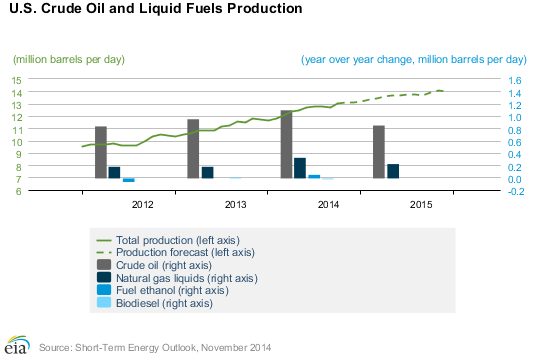
U.S. oil production has risen to 9.077 million barrels a day, and output will climb to 9.4 million next year.
Only about 4 percent of U.S. shale production needs $80 or more to be profitable, according to the Paris-based International Energy Agency. The Bakken remains profitable at or below $42 a barrel, the IEA estimates.
Miswin Mahesh, a London-based commodities analyst at Barclays Plc, said: "This opens the window for the U.S. to be the new swing producer."
EIA:
- The EIA has a positive outlook for U.S. production despite the lower price environment, revising its production forecast downward for 2015 by 80,000 bbl/d from its last forecast - 9.4 MM bbl/d in 2015.
Because of the recent decline in crude oil prices, EIA has revised U.S. crude oil production in 2015 downward by an average of 80,000 bbl/d compared with last month's forecast. As the WTI crude oil price is forecast to average $78/bbl in 2015, EIA expects to see some reduction in drilling activity because of marginal economic returns in some areas.
This will primarily occur in noncore areas of emerging and mature tight oil basins, where low-producing wells become less attractive at lower prices and companies scale back expensive exploration and research drilling.
The production forecast is not affected significantly because the wells that will not be drilled at these prices produce relatively little compared to wells in the core areas of a formation.
Oil prices remain high enough to support most drilling activity in the Bakken, Eagle Ford, Niobrara, and Permian Basin, which contribute the majority of U.S. oil production growth.
According to a review of financial statements released in recent weeks and despite lower crude oil prices, companies drilling in North American tight oil formations recorded improved financial results in third-quarter 2014 as compared with third-quarter 2013.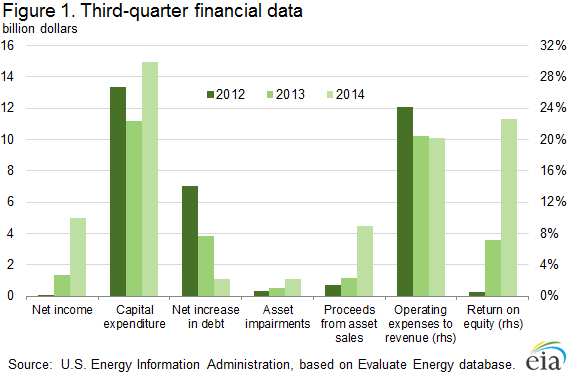
The recent financial statements for a group of 30 publicly traded companies suggest that improved operational efficiency, asset sales, and increases in the value of the companies’ hedging instruments contributed to better financial results despite front month West Texas Intermediate (WTI) crude oil prices averaging $97.24 per barrel (bbl) in the third quarter of 2014, $8.56/bbl lower than third-quarter 2013.
This group of companies, while profitable, still spent more on capital expenditures than they generated from operations. In previous quarters, they met most of the cash shortfall through capital markets, raising debt or equity, to pay for investment.
Some producers may also have chosen to protect themselves from declining crude prices by hedging. 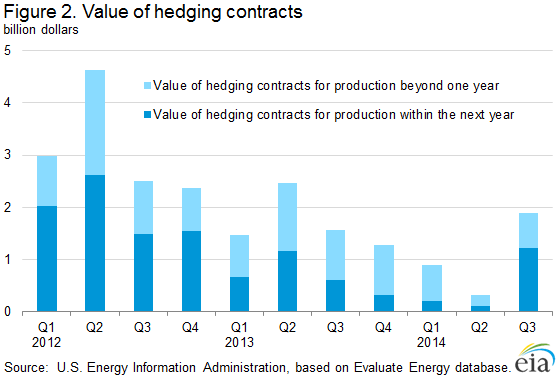
For this group of companies, the value of hedging contracts increased in the third quarter, resulting in an unrealized gain of nearly $4.1 billion (Figure 2) on previously purchased hedging contracts and the value of hedges purchased in the quarter.
Although hedges provide protection from adverse price movements, prolonged periods of lower prices could nonetheless exert financial pressure on some of these companies, particularly companies with higher costs or higher debt.
Source: EIA This Week in Petroleum, Short-Term Energy Outlook