

Production Rates | Capital Markets | Capital Expenditure
BP Grows Production; CapEx Cut Again
 Print
|
Print
|

BP has reported results for the third quarter of 2015 and set out a medium-term financial frame to balance cash flows by 2017 at around $60 per barrel.
Production
Production for the quarter was 2,242mboe/d, 4.4% higher than the third quarter of 2014. Underlying production* for the quarter decreased by 2.2%, mainly due to higher seasonal turnaround activity. For the nine months, production was 2,220mboe/d, 4.3% higher than in the same period of 2014. Underlying production for the nine months was flat versus 2014.
Capital Expenditure
BP expects organic capital expenditure will be in the range of $17-19 billion a year through to 2017, closer to $19 billion in 2015. Expectations for 2015 capital expenditure were $24-26 billion a year ago and under $20 billion in the second quarter of 2015.
Cash Flow & Debt (operating)
BP reported operating cash flow for 3Q 2015 was $5.2 billion bringing the total for the first nine months of the year to $13.3 billion. Organic capital expenditure over the nine month period was $13.2 billion. At the end of the quarter, net debt was $25.6 billion representing a gearing level of 20.0%, including approximately 1% arising from the agreements in principle to settle with the United States government and Gulf states.
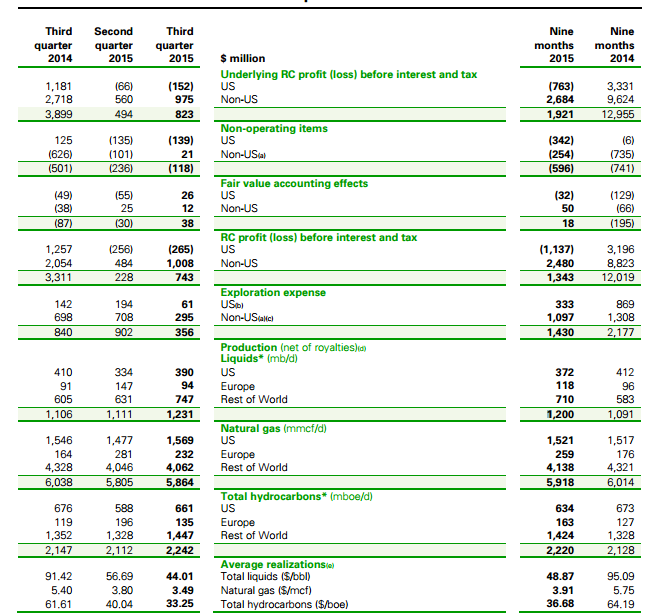
3Q 2015 results details
- BP reported underlying replacement cost profit (1) of $1.8 billion for the quarter, compared with $1.3 billion for the previous quarter and $3.0 billion for the third quarter of 2014. Compared with a year earlier, the result primarily showed the impact of sharply lower oil and gas prices but also the benefits of a continuing strong downstream environment and performance and steadily lower cash costs throughout the Group.
- Capital expenditure: Through capital discipline – optimising project economics, phasing spending and through industry deflation – BP expects organic capital expenditure will be in the range of $17-19 billion a year through to 2017, closer to $19 billion in 2015. Expectations for 2015 capital expenditure were $24-26 billion a year ago and under $20 billion in the second quarter of 2015.
- Costs: BP first began work to simplify its organisation and increase efficiency throughout the Group in 2013; this is delivering material results. Controllable cash costs for the Group over the first nine months of 2015 were $3 billion lower than in the same period of 2014. BP expects this work to extend further and by 2017 annual cash costs are expected to be over $6 billion lower than those seen in 2014.
- Divestments: BP’s current divestment programme is nearing completion with total agreed divestments expected to approach $10 billion by the end of 2015 – the total is currently $7.8 billion.
- As it continues to actively manage its portfolio, BP expects to agree a further $3-5 billion divestments in 2016 before returning to a rate of around $2-3 billion a year thereafter. Divestment proceeds are expected to provide flexibility to help manage both continuing oil price volatility and BP’s commitments in the US.
- Gearing: Since 2010, BP has maintained gearing in a band of 10-20%, providing financial flexibility to manage uncertainties, primarily those associated with the Gulf of Mexico oil spill. As progress is being made towards completion of the agreements in principle to settle with the US government and Gulf Coast states, BP now intends to manage gearing with flexibility around a level of 20%.
- BP reported operating cash flow for 3Q 2015 was $5.2 billion bringing the total for the first nine months of the year to $13.3 billion. Organic capital expenditure over the nine month period was $13.2 billion. At the end of the quarter, net debt was $25.6 billion representing a gearing level of 20.0%, including approximately 1% arising from the agreements in principle to settle with the United States government and Gulf states.
- For the Upstream segment, pre-tax underlying replacement cost profit (1) was $0.8 billion, compared with $0.5 billion in the second quarter and $3.9 billion in the third quarter of 2014. The lower result compared with a year ago was primarily due to the effect of lower oil and gas prices, partly offset by lower costs and strong gas trading results.
- The Downstream segment continued to perform strongly, reporting a pre-tax underlying replacement cost profit1 of $2.3 billion – up from $1.9 billion in the previous quarter and $1.5 billion in 3Q 2014. Compared with a year earlier, the result benefitted from improved refining margins, strong refining operations and fuels marketing and, again, cost benefits from simplification and efficiency programmes.
- BP reported estimated underlying net income from Rosneft (3) for the quarter of $382 million compared with $110 million in 3Q 2014. As previously announced BP received an annual dividend from Rosneft of $271 million during the quarter.
- During the quarter BP was awarded five new blocks in the UK North Sea. In October it was announced that, subject to government approval, BP was also awarded three shallow water blocks in the Mediterranean Sea off Egypt. The Woodside-operated Western Flank A project offshore Western Australia, the latest phase of the North West Shelf development, began production in October.
International News

Western Canada Upstream M&A: Q1 2026 Transaction Report
Western Canadian M&A activity in Q1 2026 was characterized by a 87% decrease in total deal value compared to Q1 2025, totaling $0.8 billion C$. However, transaction volume…

Whitecap Details 2026 Duvernay & Montney Program
Whitecap Resources reported strong third quarter 2025 operating and financial results, marking its first full quarter following the strategic combination with Veren that closed on May 12, 2025.…

ARC Resources: Lower 2026 Capex, Higher Volumes
ARC Resources used its third quarter update to reinforce a familiar message to Canadian E&P executives: disciplined capital, structurally better market access, and a growing shareholder return program…

Baytex 2026 Development Plans
Baytex’s 2026 development plan reflects a post–Eagle Ford sale capital program and a sharpened focus on its core Canadian assets. The Company approved 2026 exploration and development expenditures…

Tourmaline: 2026 Capital Program Locked In at $2.9B
Tourmaline’s 2026 exploration and production (EP) program is set at $2.9 billion and targets average production of 690,000–710,000 boepd, with the company maintaining the multi-year EP Plan released…
North America News

Advantage Plans $300–$330MM 2026 Capital Program
Advantage’s 2026 development plan centers on Glacier-focused drilling and key midstream work. The company plans total capital spending of $300 million to $330 million and expects production to…

Paramount Targets 42% Higher 2026 Capex, More Duvernay Wells
Paramount Resources is stepping up investment in 2026 as it advances the Willesden Green Duvernay (Central Alberta Region) buildout and launches major infrastructure at Sinclair (Montney). The company…

Birchcliff Targets Higher 2026 Output on Larger Capital Budget
Birchcliff’s updated 2025 plan targets higher production within a tightened capital range, supported by faster cycle times and lower costs. The company increased 2025 annual average production guidance…

Peyto Targets 70–80 Net Wells in 2026 on a $450–$500MM Capital Program
eyto’s preliminary 2026 development program is set at $450–$500 million, matching its 2025 capital budget of $450–$500 million. The 2026 plan is designed to be flexible, with the…

Keystone Runs Steady as Blackrod Gas Link Nears Startup
Nov. 13, 2025 South Bow’s 3Q25 update was operationally focused: the Keystone Pipeline System maintained steady utilization while the company advanced integrity work tied to the MP-171 incident,…